
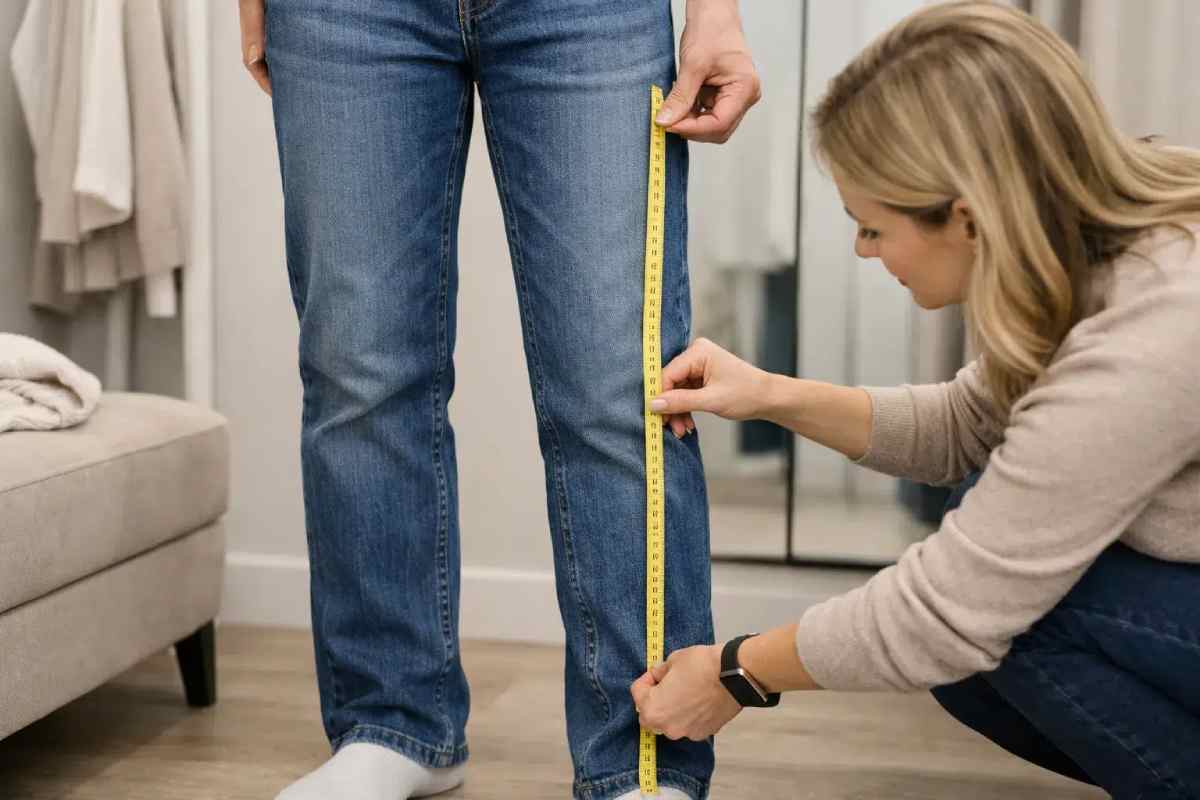
Inseam is the amount of fabric that is available between the crotch seam (where the two legs join) to the bottom of the pant leg. It is normally measured in inches (in) or centimetres (cm), is one of the two measurements that most pants labels have, the other being the waist.
Why it is important: the amount of the inseam it has is where your hem is going to start touching your shoe/ankle. The right inseam will provide a straight line, easy movement and proper style (cropped, ankle, full length and other styles).
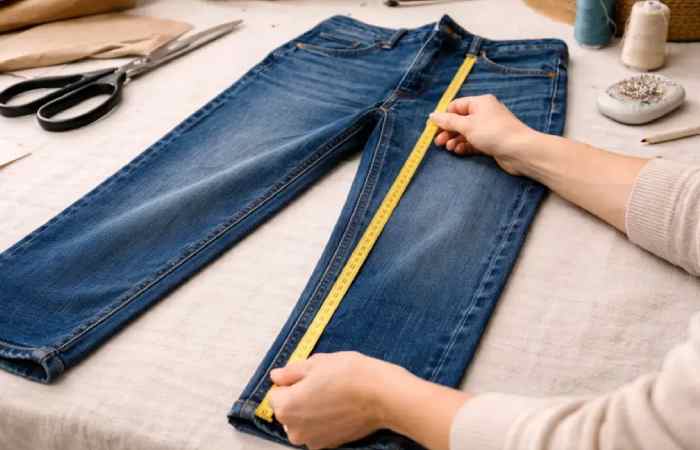
Table of Contents
Quick comparison: measurement methods at a glance
| Method | How it’s done | Accuracy | Speed | Best for |
| Measure on your body (standing against a wall) | Tape from crotch to floor | High | Medium | Tailoring, exact fit |
| Measure a well-fitting pair of pants | Lay pants flat, measure from crotch seam to hem | High | Fast | Reordering same style |
| Seated measurement (for dress pants) | Measure while sitting to allow for fold | Medium | Slower | Suit pants, ergonomic fit |
| Use a tailor/seamstress | Professional measuring tool | Very high | Slow | Formal wear, bespoke |
| Using a friend + rigid ruler | Friend measures inside leg with ruler | Medium | Medium | If no flexible tape available |
| Clothing size charts (estimate) | Use height-to-inseam chart | Low | Very fast | Quick shopping, rough estimate |
Tools you’ll need
- Flexible cloth measuring tape (recommended)
- A full-length mirror (helps when measuring standing)
- A friend (optional, but very helpful)
- A pair of pants that fit you well (if using that method)
- Flat surface (floor or table) for laying pants flat
- Pen and paper or phone to note your number
Method A — Measure your inseam on your body (best for tailoring)
This is the most accurate for a true-to-body fit.
Steps:
- Put on the undergarments or shoes you plan to wear most with the pants (shoes change where the hem should fall). For tailoring, measure barefoot and tell the tailor shoe choice later.
- Stand straight with your feet about shoulder-width apart. If possible, stand against a wall so your posture is steady.
- Ask a friend to help (recommended). If alone, a mirror helps, but it is trickier.
- Place the end of the tape at the crotch (the point where the seam would naturally meet).
- Run the tape down the inside of your leg to the point you want the hem to sit:
- For dress pants: just touching the top of the shoe heel.
- For jeans (classic): break slightly on shoe (a small fold).
- For cropped/ankle pants: mid-ankle.
Record the measurement in inches and cm (1 in = 2.54 cm). Round to the nearest 0.25 inch if needed.
Tips:
- Keep the tape snug but not tight.
- Measure both legs if you suspect asymmetry. Use the longer measurement for comfort.
Method B — Measure a pair of pants that already fits (fast & reliable)
If you own pants that fit the way you like, this is the easiest method.
Steps:
- Lay the pants flat on a table or floor, smoothing out wrinkles.
- Find the crotch seam where the two legs meet.
- Put the tape measure at that seam and measure straight down the inside leg seam to the hem.
- Read the measurement (inches/cm).
- If the hem is rolled or cuffed, measure to where you normally wear the hem or unroll before measuring.
Why it’s great: removes body-posture variation and is exactly what you already like.
Method C — Seated or ergonomic inseam (for suits & bike shorts)
Some garments fit differently when you’re seated (dress pants, cycling shorts). Seated measuring accounts for hip/posterior compression.
Steps:
- Sit comfortably with your knees bent at a normal angle (about 90 degrees).
- Place the tape at the crotch seam (you can stand to mark that point, then sit).
- Measure down the inside of the leg to where you want the hem to sit while seated.
- Add 1–2 cm (0.5–1 in) to account for movement if the pants are for standing/walking too.
Use this for garments meant to be comfortable in both positions.
Common mistakes (and how to avoid them)
| Mistake | Why it happens | Fix |
| Measuring to the floor every time | Doesn’t account for shoe heel or hem style | Decide desired hem endpoint first (shoe/top of foot/ankle) |
| Measuring outside the leg | Gives larger number | Always measure inside seam from crotch to hem |
| Measuring over thick clothing | Inflates number | Measure in thin clothing or over underwear |
| Not noting shoes | Changes where hem lands | Always note shoe type used when measuring |
| Using a non-flexible ruler | Hard to reach crotch seam curvature | Use a cloth tape measure |
Sample inseam chart — typical suggested inseams by height
Use as a starting point if you can’t measure right now. These are approximate and vary by leg length proportions and style preferences.
| Height (cm) | Height (ft/in) | Typical men’s inseam (in) | Typical women’s inseam (in) |
| 152 cm | 5’0″ | 27–29 | 26–28 |
| 157 cm | 5’2″ | 28–30 | 27–29 |
| 163 cm | 5’4″ | 29–31 | 28–30 |
| 168 cm | 5’6″ | 30–32 | 29–31 |
| 173 cm | 5’8″ | 31–33 | 30–32 |
| 178 cm | 5’10” | 32–34 | 31–33 |
| 183 cm | 6’0″ | 33–35 | 32–34 |
| 188 cm | 6’2″ | 34–36 | 33–35 |
Note: Women’s inseams for the same height are often 1–2 inches shorter, depending on where they prefer the hem to sit. Always measure your own body or a favorite pair of pants for accuracy.
Inch ⇄ Centimetre conversion table (quick reference)
| Inches (in) | Centimetres (cm) |
| 26 in | 66.0 cm |
| 27 in | 68.6 cm |
| 28 in | 71.1 cm |
| 29 in | 73.7 cm |
| 30 in | 76.2 cm |
| 31 in | 78.7 cm |
| 32 in | 81.3 cm |
| 33 in | 83.8 cm |
| 34 in | 86.4 cm |
| 35 in | 88.9 cm |
| 36 in | 91.4 cm |
Comparison table: tailor vs DIY vs using existing pants
| Concern | Tailor measurement | Measure on body | Measure existing pants |
| Accuracy for bespoke fit | Excellent | Very good | Excellent (for same style) |
| Time | Takes longer (appointment) | Moderate | Fast |
| Cost | Paid service | Free | Free |
| Best use | Suits, formal wear, unique body shapes | Everyday clothing & online orders | Reordering same brand/style |
| Downsides | Needs appointment, cost | Hard solo, needs helper for best accuracy | Not useful if pants style changes (cuffed/stacked) |
Special situations & garment types
Jeans and casual pants
- Jeans are often sold by nominal inseam lengths (e.g., 30″, 32″). Measure how you like them to break over your shoe. Levi’s – How to Measure Jeans
- For high-rise jeans, fit at crotch may shift hem position slightly; always prefer measuring a pair you already own.
Cropped or ankle pants
- Decide the visual point (just above ankle bone? mid-ankle?). Measure to that exact spot.
Leggings and activewear
- Measure with the same intended wear (with sneakers) — some are designed to be full-length, others 7/8 length.
Shorts
- Inseam for shorts is the inner seam length of the short leg. Decide preferred short length: 3″, 5″, 7″ (men’s) or above/below mid-thigh (women’s).
Children & babies
- For kids, measure from crotch to where pant should end on leg. Leave growth room (0.5–2 in) depending on how fast they grow. Wrangler – Fit & Size Guide
What if measurements don’t match expectations?
| Symptom | Possible cause | Fix |
| Pants sag at the crotch | Rise too low or inseam too long | Choose different rise or shorter inseam |
| Pants ride up when sitting | Inseam too short or waist too tight | Increase inseam or adjust waist fit |
| Hem puddles around shoes | Inseam too long | Shorten by 1–3 inches depending on excess |
| Asymmetric hem | Body asymmetry or manufacturing variance | Measure both legs; tailor for asymmetry |
FAQ
Q: Should I measure while wearing shoes?
A: For everyday jeans, yes—measure with the type of shoe you’ll wear most. For formal tailoring, measure barefoot and tell your tailor the shoe heel height.
Q: Which is more accurate — measuring myself or measuring pants?
A: Measuring a pair of pants you already love is usually very accurate for repeating that look. On-body measurement is better for a bespoke fit or when no well-fitting pants are available.
Q: Can I use a string instead of a measuring tape?
A: Yes — mark the string, then measure the string with a ruler.
Q: How often do I need to re-measure?
A: After significant weight change, injury, or major posture change. Otherwise, keep the value for brand shopping once.
Final words
A right inseam leaves clothes to seem they should have been made to you. Invest 5 minutes doing it right, and you will save time, money, and frustration. Whether it is to hemming a pair of money-cherishing trousers, online shopping of jeans, or custom-made pants, it is your inseam that creates an appearance of perfection.