
Most of us have been there — standing in front of what seemed like a perfectly good mirror, finishing our makeup, stepping into daylight, and realising something has gone badly wrong. Foundation that looked blended looks patchy. Eyeshadow that looked smoky looks heavy. Liner that looked precise looks wonky.
The mirror didn’t lie to you. It just wasn’t built for what you were trying to do.
Here’s how to choose one that is.
Table of Contents
The Real Reason Your Current Mirror Isn’t Working
Before getting into specs and styles, it helps to understand why most bathroom and bedroom mirrors fail for makeup application. The problem almost always comes down to one thing: light direction.
Standard mirrors — bathroom wall mirrors, bedroom full-lengths, even decorative dressing table mirrors without illumination — rely entirely on whatever light is already in the room. In bathrooms, that’s usually a ceiling fitting or downlights, both of which project light from above. In bedrooms, it’s typically a pendant or bedside lamp, which means the light comes from behind or beside you.
Both of these create the same problem: shadows fall where you’re trying to see most clearly. Undereye hollows deepen, the sides of the nose go dark, and the light temperature usually bears no relation to natural daylight. What you see is a version of your face shaped by the room’s lighting — not by accurate, neutral illumination.
A purpose-built makeup mirror solves this at the source.
What Makes an Illuminated Makeup Mirror Different
The defining feature of a proper makeup mirror is that the light source is front-facing, surrounding the reflection area at face level. This mimics the way professional makeup artists and film and TV studios have lit actors and subjects for decades — evenly from the front, eliminating directional shadows entirely.
The practical result: what you see in an illuminated makeup mirror is what other people will see in daylight. Colour, texture, blending, and coverage are all visible as they actually are, not distorted by a light source that’s above or behind your head.
If you’ve ever wondered why your makeup looks better when you do it near a window, this is why. A good illuminated mirror replicates that quality of light regardless of what time of day it is or what else is happening in your room.
LED vs Incandescent Bulb Mirrors: Does It Matter?
If you’re shopping for an illuminated mirror, you’ll encounter two main light source types: LED strips and the classic Hollywood-style individual bulbs. Both work, but they behave differently.
LED strip mirrors produce even, diffused light with minimal shadows between individual points. They’re typically slimmer, more energy-efficient, and longer-lasting. Most modern LED makeup mirrors allow you to adjust colour temperature — from warm white (around 3000K, similar to candlelight) to cool daylight (around 6000K). The daylight setting is what you want for makeup application. Warm settings are fine for ambience but will shift your colour perception.
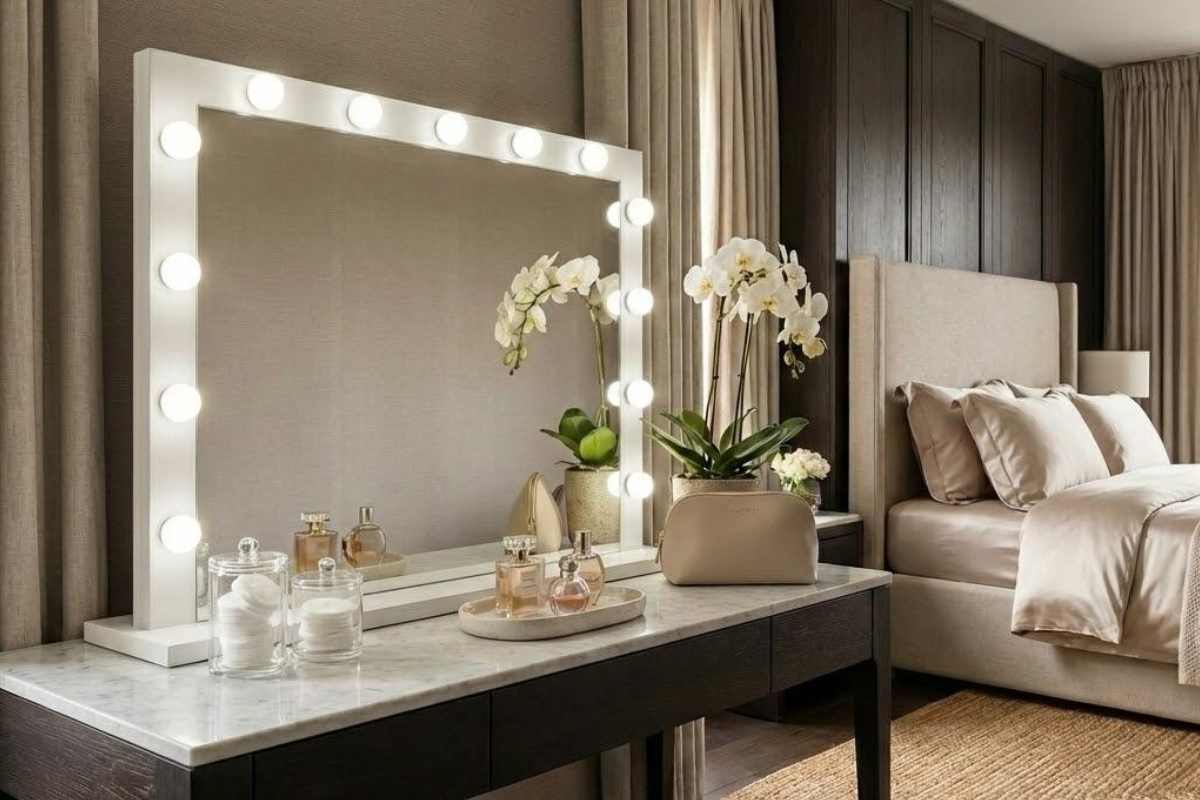
Bulb-surround mirrors — the classic Hollywood vanity look — give a warmer, slightly theatrical quality of light. Individually, the bulbs produce a slightly less even spread than LED strips, but the overall effect when all are lit is still strong and front-facing. They also look genuinely beautiful as a piece in a room, which is worth something.
For pure function, LED with adjustable colour temperature is the most versatile option. If aesthetics matter as much as performance and you like a more glamorous setup, the bulb-surround style delivers both. Our guide to building a full vanity routine from scratch covers how to style the space around whichever mirror you choose.
Mirror Size: The Bit Most People Get Wrong
Bigger than you think. That’s the answer.
The instinct, especially in small spaces, is to choose a mirror that feels proportionate to a compact surface. In practice this usually results in a mirror too small to be genuinely useful — one where you can only see part of your face at once, and have to tilt, lean, or crane to see what you’re doing.
A practical size guide for a makeup mirror used at a dressing table or vanity:
- The mirror should be wide enough to see your full face with a few centimetres clear on either side — this typically means at least 50cm width
- It should be tall enough to see from the crown of your head to your collarbone without repositioning — which for most people means at least 60cm height for a tabletop mirror
- For a wall-mounted mirror used in a dedicated makeup area, going larger (70–100cm) is rarely something people regret
Round and oval formats work well for smaller setups — the softer edge reduces the visual footprint while still giving you good coverage. Rectangular mirrors in a slim frame are the most versatile if you’re not sure what style to commit to.
Magnification: Do You Actually Need It?
Magnifying mirrors (typically 5x or 10x) are useful for very specific tasks: applying individual false lashes, doing precise liner work, skincare inspection, brow grooming. For general makeup application — foundation, blush, contour, eyeshadow — magnification actively works against you, because you lose spatial awareness of how areas of the face relate to each other.
If you apply makeup daily and want one mirror that does most things well, a standard (1x) illuminated mirror with a separate small magnifying mirror for detail work is a more practical setup than a primary mirror with built-in magnification. You can read more about how magnification affects makeup precision in this breakdown we did on mirror types and when each one earns its place in a routine.
Placement: Getting the Most From Your Mirror
A good mirror in a bad position still won’t give you what you need. A few placement principles worth following:
Eye level matters more than you think. The centre of the mirror should sit at approximately your eye level when you’re seated. Mirrors mounted too high — which is the most common error — mean you’re always looking slightly upward, which changes how shadows fall and how you perceive proportions.
Avoid placing a mirror directly opposite a window. It sounds counterintuitive given that daylight is what you’re trying to replicate, but a mirror facing a bright window will create glare that actually makes it harder to see. Position the mirror perpendicular to the light source, or rely on the mirror’s own illumination with room lighting controlled.
Think about the socket before you commit to a position. An illuminated mirror with a cable draped visibly across a wall or running along a skirting board undermines the look of even a very tidy setup. Wall-mounting above an existing socket, or having an electrician add a socket in the right position, is worth doing once rather than compromising forever.
What to Look For at a Glance
If you’re comparing options and want a quick checklist:
- Light source: LED preferred for versatility and longevity
- Colour temperature: Adjustable 3000K–6000K gives you the most flexibility
- Dimmer control: Touch or dial dimmer built into the frame, not inline on the cable
- Size: At least 50cm wide and 60cm tall for a tabletop mirror used for full face makeup
- Glass quality: High-definition silvered glass gives a clearer, more colour-accurate reflection than standard
- Mounting: Decide between tabletop (flexible, portable) and wall-mounted (cleaner look, frees surface space) before you buy, as they’re built differently
A well-chosen, well-positioned makeup mirror is one of those upgrades that changes a daily routine in a way that’s immediately and consistently noticeable. It’s also one of the more durable purchases in a beauty setup — a quality LED mirror should last years without the light source degrading. Worth getting right the first time.
This guide was produced in collaboration with the team at Hollywood Mirrors, specialists in professional LED vanity mirrors for home use.
Also Read: Face Toner vs Cleanser vs Essence: What’s the Difference and Do You Need All Three?